…as Sam Omatseye examines “democracy” at OAU lecture
Ekiti State Governor, Mr Biodun Oyebanji, has canvassed entrenchment of politics without bitterness to ensure a more virile, stronger and lasting democracy that will deliver quality governance to Nigerians.
As Ekiti State gears up for the conduct of governorship election in June and as Nigeria inches nearer to the general elections in 2027, Oyebanji enjoined political actors not to turn elections to war, adding that winner-takes-all mentality should be discouraged.
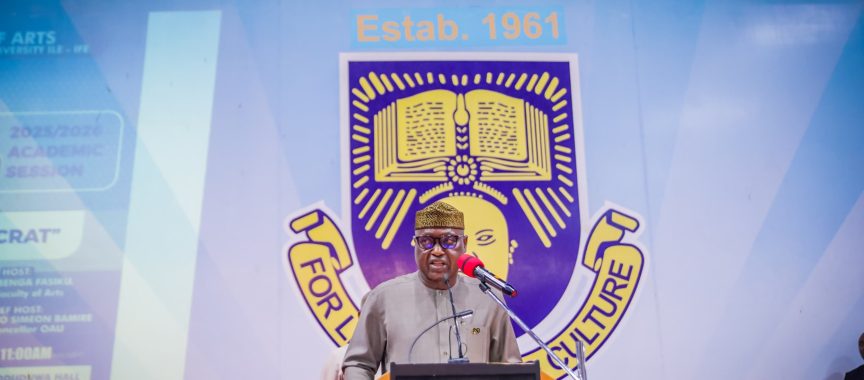
The Governor made the remarks on Thursday at the Faculty of Arts Distinguished Alumni Lecture at the Obafemi Awolowo University (OAU), Ile Ife. He noted that politics of inclusion being practised by his administration has added value to governance and engendered peace in Ekiti State as widely acknowledged.
The OAU Faculty of Arts Distinguished Alumni Lecture chaired by Governor Oyebanji and also attended by his Osun State counterpart, Senator Ademola Adeleke was delivered by the Chairman, Editorial Board of The Nation Newspapers, Mr Sam Omatseye who graduated from the university with a bachelor’s degree in History in 1985.
Addressing gathering in his capacity as the chairman of the lecture titled: “How to Make a Democrat”, Governor Oyebanji used the forum to advocate a political culture that promotes consensus building, cooperation, inclusion, decent public conduct, willingness to play by the rules and magnanimity in both electoral victories or losses.
Describing consensus building as strength and not weakness, the Ekiti helmsman further canvassed the need to always defuse public rhetoric with conciliatory and peaceable communication as such will help reduce resort to violence and other anti-democratic practices.
While admitting that democracy is a tough job anywhere in the world as it is always characterized by plurality, contestations, group conspiracies, clash of interests and power struggle, Oyebanji said the capacity to manage differences remain the major challenge that many democratic nations continue to confront.
Drawing from his experience as a player in the Ekiti political arena for about 30 years, Oyebanji charged stakeholders in democracy to play politics of inclusion which, he noted, is on full display in the Ekiti, a de elopement he said has continued to make the state peaceful under his leadership.
He said: “Election does not have to be war, and winners do not have to take all.
As a person who has been actively involved in the politics of Ekiti from 1997, passing through all the facets and the phases of its evolution, the singular lesson I have learnt is that raw power, politics of exclusion and political intolerance is a recipe for instability and rancour.
“It is for this reason that I am persuaded by the principle of politics without bitterness. Upon my assumption of office as Governor, I deliberately chose to reach out to all the differing political tendencies in Ekiti both intra-party and inter-party through inclusion, respect and solidarity.
“This approach was initially met with resistance and skepticism by majority of my party members but gradually, they became receptive. Today, I am glad to state that Ekiti which used to be notorious for troubling political crises some years ago, is, today, one of the most politically stable and monolithic in Nigeria.
“I believe we should be deliberate in building a political culture that is based on the character of our Omoluabi ethos. We cannot afford to promote extreme political point of views that create fractures and stalled development. This is more so, if one considers our current stage of socioeconomic and political development.”
Commending the lecturer, Mr Sam Omatseye, for the brilliant lecture, Oyebanji also hailed Omatseye’s contribution to journalism, public discourse, social commentary, intellectual engagement and poetry describing him as “a distinguished alumnus by all standard that every University would be proud to have.”
Osun Governor Adeleke who was represented by the Commissioner for Education, Mr Dipo Eluwole, commended the faculty for organizing the lecture which he described as a platform that speaks to values of citizenship and scholarship.
He pledged the readiness of the Osun State government to always invest in education in general and also support tertiary education which he identified as the bedrock of the nation’s manpower development.
Omatseye, in the lecture titled “How to make a Democrat”, stressed the need to make a distinction between a republic and a democracy with many countries calling themselves democracies despite not practising its tenets and ethos.
Omatseye said: “Countries often call themselves democracies. A republic installs an infrastructure of mediation between the people and state. Democracy is idealist; so there is no real democracy, including the United States.
He described the opportunity to deliver the distinguished Alumni Lecture as a fulfilling privilege for him which offered him an avenue return to his alma mater to share his thoughts on issues of democracy and governance.
Omatseye, who cited many historical and contemporary instances, submitted that many nations merely lay claim to the practice of democracy without an iota of respect for the tenets of democracy.
He cited the recent American invasion of Venezuela, a sovereign country and the “abduction” of its president to the US.
“If the United States is the number one democracy in the world, then by implication, it means its President should be the number one democrat in the entire World. He then wondered why and how the in invasion of Venezuela and the abduction of its president align with democracy.
Omatseye concluded that democracy is more of an idealism. According to him, countries often call themselves democracies. A republic installs an infrastructure of mediation between the people and the state. Democracy pretends there is none.
“Democracy is idealist. There is no real democracy, including the United States. All who operates in republics call themselves democrats. So, if democracy is aspirational why should the democrat be perfect?
“In our own case, it is because the democrat has always been half-born. To have a democrat in full, they must be allowed to grow with all their witch facts and beauties . Too many ingr die ya made a democrat. The most important one is often not canvassed by scholars. It is called time”, he concluded.
In attendance at the lecture, which took place at the Oduduwa Hall of the OAU were the Osun State Governor, who was represented by the Commissioner for Education, Mr Dipo Eluwole; Asiwaju Bola Oyebamiji, Govermorship candidate of the APC Osun State; Secretary to Ekiti State Government, Prof Habibat Adubiaro; Chief of Staff, Mr Niyi Adebayo; Commisisoner for Education, Dr Olabimpe Aderiye; Special Adviser Tertiary Education, Prof Akeem Azeez; Special Adviser Office of Transformation and Service Delivery, Dr John Ekundayo; Special Adviser on Media and Startegy, Mr Yinka Oyebode and Director General office of Community Communications, Mrs Mary Oso- Omotoso and representatives of youth and students organisations from Ekiti State.
Last modified: January 29, 2026